Key Takeaways:
- The Constitutional Court has confirmed that businesses’ disclosure obligations include colour-and-symbol labels on packaged foods and beverages containing sugar, salt, and fat.
- BPOM Regulation No. 10 of 2026 already provides a Nutri-Level framework for specified beverage categories.
- Businesses should distinguish the Court’s broader ruling from the scope, technical standards, and implementation periods under existing regulations.
- A product-by-product compliance review can help businesses plan laboratory testing, packaging changes, and coordination with suppliers.
A Broader Disclosure Obligation for Food and Beverage Businesses
Indonesia’s food labelling framework is evolving towards information that consumers can understand more easily when choosing products.
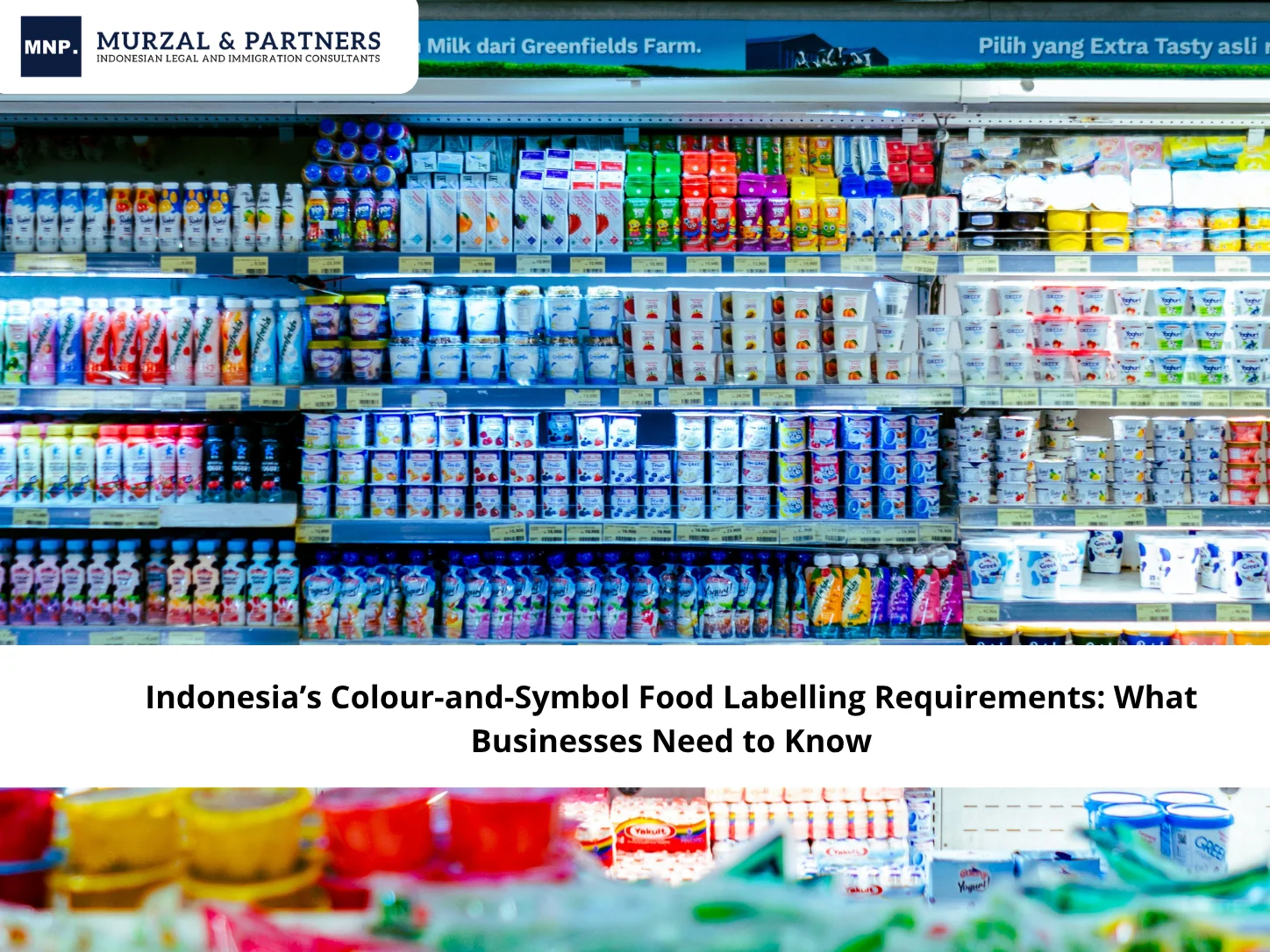
On 29 September 2026, the Constitutional Court issued Decision No. 110/PUU-XXIV/2026 concerning the Consumer Protection Law and the Health Law. The ruling expressly incorporates colour-and-symbol labelling into businesses’ information obligations for packaged foods and beverages containing sugar, salt, and fat.
For businesses, the practical task is to assess how this broader obligation interacts with the technical rules that already govern particular products
What Did the Constitutional Court Decide?
For general naturalization, Article 9 of Law 12/2006 requires the applicant to:
- Be 18 years of age or married.
- At the time of
The Court conditionally interpreted two statutory provisions:
- Article 7(b) of Law No. 8 of 1999 on Consumer Protection: businesses’ obligation to provide correct, clear, honest, and adequate information includes colour-and-symbol labels on relevant food and beverage packaging.
- Article 148 of Law No. 17 of 2023 on Health: the Central Government and Regional Governments’ regulatory and supervisory responsibilities include requiring businesses to display those labels.
The ruling therefore addresses both business disclosure and government oversight.
Constitutional Court decisions acquire binding legal force upon pronouncement in an open plenary hearing. Businesses should nevertheless assess implementation by reference to the applicable product regulations and any subsequent official clarification.
application, have resided in Indonesia for at least 5 consecutive years or 10 non-consecutive years. - Meet physical and mental health requirements.
- Be able to use the Indonesian language and acknowledge Pancasila and the 1945 Constitution.
- Not have a criminal conviction for a criminal offense punishable by imprisonment of 1 year or more.
- Not become a dual citizen as a result of acquiring Indonesian citizenship.
- Have employment and/or a fixed income.
- Pay the naturalization fee to the state treasury.
The residence period needs to be proven through immigration documents. Therefore, applicants should compile their history of stay permits, addresses, and international travel before submitting an application. Holding a KITAP alone does not replace the review of all naturalization requirements.
Existing Nutri-Level Rules Must Also Be Considered
The regulatory position extends beyond the Court’s ruling. Two instruments are particularly relevant.
Ready-to-serve beverages
Minister of Health Decree No. HK.01.07/MENKES/301/2026 addresses nutrition labels and health messages for ready-to-serve processed beverages, beginning with large-scale businesses.
It introduces Nutri-Level classifications from A to D, using dark green, light green, yellow, and red. Labels may appear on menus, retail packaging, commercial electronic applications, and other information media. The decree requires supporting laboratory testing and provides that mandatory application begins two years after the establishment of maximum sugar, salt, and fat limits under applicable legislation.
Specified packaged beverage categories
BPOM Regulation No. 10 of 2026 on Nutrition Information on Processed Food Labels establishes a separate framework covering Nutri-Level labelling for ready-to-consume beverages, powdered beverages, and liquid and solid concentrates.
BPOM explains that the classification uses sugar, sodium, and total fat content per 100 ml of the product as prepared for consumption. Its official guidance also identifies a 24-month transition period from promulgation on 17 June 2026.
Businesses should therefore avoid assuming that the Ministry of Health and BPOM frameworks have identical coverage, assessment methods, or implementation triggers.
Which Implementation Questions Remain?
In MNP’s view, the key issue is how the Court’s broader interpretation will operate alongside these product-specific frameworks.
Matters requiring careful assessment include:
- How colour-and-symbol requirements will apply to food categories that fall outside the current beverage framework.
- Whether further rules will prescribe category-specific thresholds or exemptions.
- How existing transitional provisions will interact with the ruling.
- How the relevant authorities will coordinate supervision and enforcement.
The existence of technical rules for certain beverages should not be treated as resolving every question concerning all packaged foods. Equally, businesses should not assume that no preparation is necessary while further guidance is awaited.
Practical Steps for Businesses
MNP recommends incorporating the following steps into a compliance review:
1.Map the product portfolio.
Identify product categories, formulations, packaging formats, and the entities responsible for manufacturing, importing, and distributing each product.
2. Check the applicable framework.
Determine which requirements apply to each product and record the relevant technical standards and implementation dates.
3. Validate nutrition data.
Review laboratory reports and calculation methods before assigning a classification. Data prepared for one framework may require reassessment before use under another.
4. Plan packaging changes.
Coordinate legal, regulatory, production, and marketing teams to assess artwork, printing schedules, existing stock, and approval requirements.
5. Clarify responsibilities with commercial partners.
Review arrangements with manufacturers, suppliers, and distributors concerning testing, label approval, packaging costs, and regulatory updates.
How MNP Can Assist
Murzal & Partners Law Firm assists businesses with Indonesian regulatory compliance, consumer protection, and commercial arrangements. Our support can include reviewing applicable labelling obligations, assessing implementation requirements, and advising on responsibilities across the supply chain.
For advice on how these developments may affect your products or operations in Indonesia, please contact our team.
This article provides general legal information and does not constitute legal advice. The applicable requirements should be assessed against the relevant product, business activities, and prevailing regulations.