Key Takeaways:
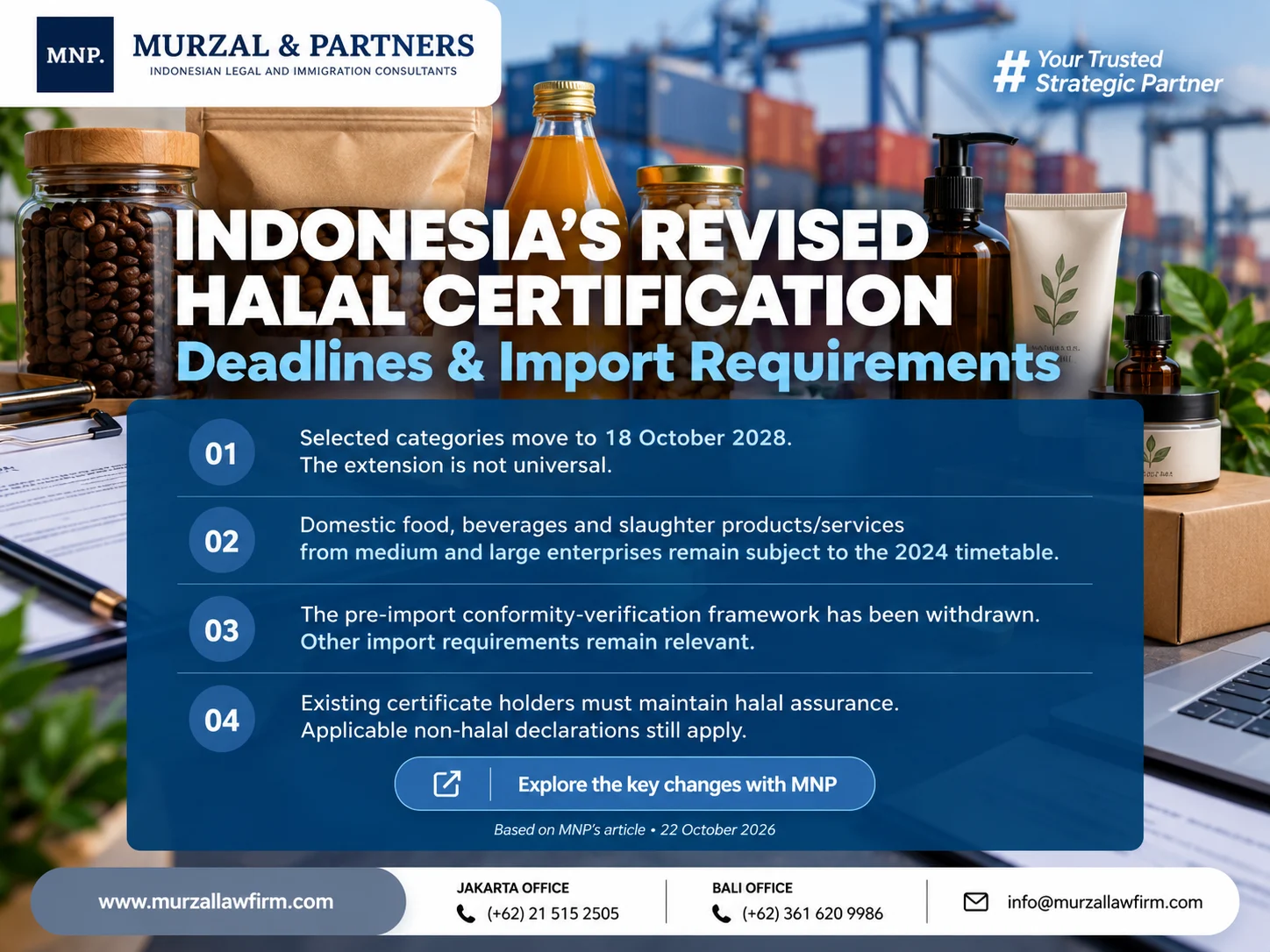
- Indonesia has extended the halal-certification implementation period for specified products, services, and business categories, with many obligations now applying from 18 October 2028.
- The extension is not universal. Businesses must assess product classification, business scale, and product origin before applying the revised timetable.
- The conformity-assurance framework supporting pre-import verification of foreign halal products has been withdrawn.
- Existing certificate holders must continue meeting their halal-assurance obligations. Non-halal declarations and applicable administrative sanctions also remain relevant.
What Has Changed?
Government Regulation No. 40 of 2026 (“GR 40/2026”) amends Government Regulation No. 42 of 2024 on the Administration of Halal Product Assurance. The amendment was promulgated on 14 October 2026 and took effect on the same date.
The changes concern the implementation timetable for mandatory halal certification and the conformity-assurance framework for foreign halal products. BPJPH’s official legal database also records the revocation of BPJPH Regulation No. 4 of 2026 on conformity assurance for foreign halal products entering Indonesia.
For businesses, the immediate priority is to identify which requirements have changed and which obligations continue to apply.
Which Halal Certification Dates Apply?
The revised timetable distinguishes between product categories, related services, business scale, and imported products.
The table below summarises the principal implementation dates:
| Product or business category | Mandatory certification applies from |
|---|---|
| Food, beverages, slaughter products, and slaughter services supplied by micro and small enterprises | 18 October 2028 |
| Imported food, beverages, slaughter products, and slaughter services, taking account of the completion of mutual-recognition arrangements | 18 October 2028 |
| Services related to food, beverages, and slaughter products, excluding slaughter services | 18 October 2028 |
| Natural medicines, quasi-drugs, health supplements, and cosmetics | 18 October 2028 |
| Chemical and genetically engineered products within the regulated scope relating to food, beverages, medicines, or cosmetics | 18 October 2028 |
| Specified consumer goods and Class A medical devices within the relevant animal-derived material categories | 18 October 2028 |
| Over-the-counter medicines, limited over-the-counter medicines, and Class B medical devices | 18 October 2029 |
| Prescription medicines other than psychotropics, and Class C medical devices | 18 October 2034 |
The amended phasing provisions appear in Articles 160 and 161. Businesses should distinguish the last day of the implementation period, generally 17 October of the relevant year, from the following day on which mandatory certification applies.
The table is a planning summary. Specific classifications, material-related limitations, exemptions, and special provisions must be checked against the relevant product.
The Extension Does Not Cover Every Business
A significant distinction concerns domestically produced food, beverages, slaughter products, and slaughter services supplied by medium and large enterprises. Their implementation period ended on 17 October 2024.
Those businesses should therefore not assume that the new 2028 timetable provides an additional certification period for products already subject to mandatory requirements. The government has expressly explained that the adjustment does not apply uniformly across all products and businesses.
In MNP’s view, a company-wide assumption that “halal certification has been postponed” creates avoidable compliance risk. The assessment should be conducted separately for each product category and relevant business activity.
What Does the Withdrawal of Pre-Import Verification Mean?
The amendment withdraws the conformity-assurance provisions supporting the pre-import verification framework under BPJPH Regulation No. 4 of 2026. That framework should consequently be removed from compliance procedures that treated it as a mandatory pre-import step.
Businesses should distinguish that withdrawal from other requirements governing imports and the recognition or registration of foreign halal certificates.
Importers should review which requirements remain applicable to their products, including the relevant certification route, foreign certification body recognition, labelling, and product-specific import approvals. The revised halal timetable does not itself remove other import obligations.
Non-Halal Declarations Remain a Separate Requirement
Products made from prohibited materials are treated differently from products awaiting halal certification. The exemption from halal certification for non-halal products is accompanied by an obligation to provide the applicable non-halal declaration.
BPJPH Regulation No. 3 of 2026 governs the form and procedures for these declarations. Its scope includes products originating from prohibited materials and products produced through processes that do not meet halal criteria. The assessment can therefore extend beyond the ingredient list.
Businesses should avoid treating the absence of a halal certificate as automatically determining that a product is non-halal. Product composition, processing, and the applicable legal classification require separate assessment.
Existing Certificate Holders Must Maintain Compliance
The additional preparation time does not suspend the obligations attached to existing halal certificates.
Certified businesses should continue implementing their Halal Product Assurance System (Sistem Jaminan Produk Halal or “SJPH”), maintaining traceability and controlling production and handling processes. Changes to ingredients or halal production processes may require certificate updating under Article 90 of Regulation 42/2024.
The administrative sanctions framework also remains relevant to obligations that continue to apply. The applicable requirement and implementation date should be established before assessing a particular compliance failure.
Practical Steps for Businesses
MNP recommends using the additional preparation period to complete the following work:
- Build a product-specific compliance register.
Record each product’s category, origin, ingredients, certification status, related services, and applicable implementation date. - Confirm the certification route.
For imported products, establish how the foreign manufacturer’s certification arrangements will support compliance in Indonesia. - Review labels and product claims.
Check halal marks, non-halal declarations, packaging, and marketing materials against the requirements applicable to each product. - Update import procedures.
Remove steps based solely on the withdrawn verification framework while retaining other applicable controls. - Strengthen supplier and operational controls.
Obtain supporting documentation and establish a process for reviewing changes to ingredients, suppliers, facilities, and production methods. - Set an internal completion date.
Allow time for document preparation, assessment, corrective action, and packaging changes before the statutory implementation date.
How MNP Can Assist
Murzal & Partners Law Firm assists businesses with Indonesian regulatory compliance, product distribution, and international trade arrangements.
Our support can include assessing the applicable halal-certification timetable, reviewing certification and labelling requirements, advising on import procedures, and coordinating with relevant authorities and certification stakeholders.
For advice on how these developments affect your products or operations in Indonesia, please contact our team.
This article provides general legal information and does not constitute legal advice. Applicable requirements should be assessed against the relevant product, business scale, product origin, and prevailing regulations.
Permenkum 15/2026 on Citizenship Services was promulgated on 21 September 2026. Article 129 provides that the regulation takes effect 3 months after promulgation; JDIH BPK lists the effective date as 20 December 2026. As of 10 October 2026, the new provisions are not yet the procedure currently in force.
For naturalization at one’s own request, the new rules detail electronic submission, expanded supporting documents, biometric collection, a written assessment, an interview, and factual verification. Additional documents include a certificate of Indonesian language proficiency with an outstanding rating and several statements from the relevant authorities.
When the new regulation takes effect, applicants need to check the date of submission, the type of service, the transitional provisions, and the implementation of the electronic system. Applicants who have already submitted an application should not assume that their entire file will automatically follow the same procedure as a new application.