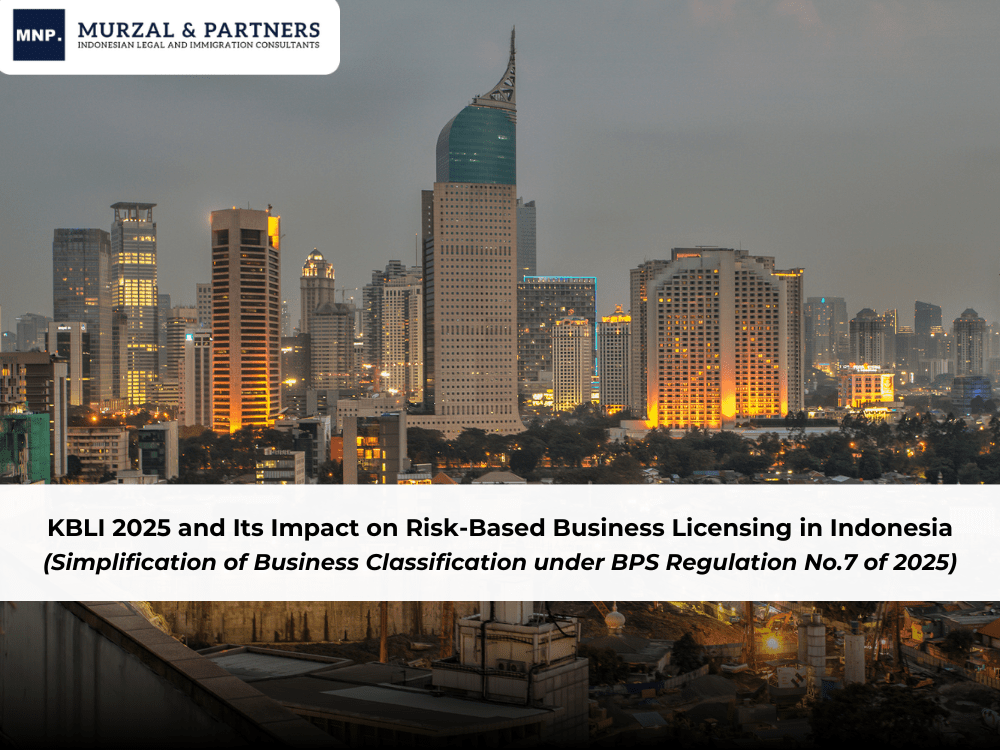
Through the Central Statistics Agency (Badan Pusat Statistik – “BPS“), the Government of Indonesia has issued BPS Regulation No. 7 of 2025 on the Indonesian Standard Classification of Business Fields (“BPS Regulation 7/2025“), which entered into force on 18 December 2025. This regulation replaces BPS Regulation No. 2 of 2020 and introduces a new structure for the Indonesian Standard Classification of Business Fields (Klasifikasi Baku Lapangan Usaha Indonesia – “KBLI“), which serves as the main foundation of the risk-based business licensing system.
The KBLI 2025 update is not merely administrative in nature. It reflects the transformation of the national economy, shaped by digitalization, technological innovation, the energy transition, and the emergence of new business models. Accordingly, KBLI now functions not only as a statistical instrument but also as a policy tool that influences licensing, supervision, and cross-sectoral investment direction.
Aligning Business Classification with the Modern Economy
KBLI plays a strategic role in determining a business’s risk level, the type of licensing required, and the form of government oversight. As the economy grows more complex, marked by digital platforms, factoryless production, carbon trading, and renewable energy, the previous KBLI structure no longer fully reflects the realities of business activity.
Through BPS Regulation 7/2025, the government seeks to improve regulatory clarity and statistical accuracy, while ensuring that business classification can accommodate new business models and support the sustainability agenda. This alignment is essential to create consistency between business classification, risk-based licensing, and evolving sectoral policy.
Addition and Refinement of Business Categories
One of the fundamental changes in KBLI 2025 is the increase in the number of categories from 21 to 22. This addition results from splitting the Information and Communication category into two more specific categories: one focused on content production and distribution, and the other covering telecommunications and digital infrastructure services.
This split reflects a shift in the structure of the digital economy, in which the content industry and information-technology services have developed with distinct regulatory characteristics and business models. The category focused on publishing, broadcasting, as well as content production and distribution, emphasizes the management of copyright and the exploitation of intellectual works. Meanwhile, the category covering telecommunications, computer programming, cloud computing, and cybersecurity focuses on the provision of infrastructure and technical services. This refinement helps digital businesses determine the classification that most accurately reflects their primary economic function.
In addition, a number of categories have had their names and scope adjusted to improve clarity and reduce overlap between sectors. This change reflects an effort to simplify the classification structure without reducing the representation of evolving economic activities.
Reorganization of the Trade and Repair Services Sector
A significant restructuring has occurred in the trade sector, particularly with respect to motor vehicle trade and repair activities. Under KBLI 2020, these activities fell within a single category together with wholesale and retail trade. KBLI 2025, however, separates vehicle repair activities and reclassifies them as part of other service activities.
This approach reflects a shift toward more functional classification, in which repair activities are positioned as service activities rather than as part of trade. For businesses, this change requires remapping their KBLI classification, which may affect their business risk level and the type of licensing required. Companies must therefore ensure that their new classification continues to accurately reflect their actual business activities.
Recognition of Digital Platforms and Factoryless Production Models
KBLI 2025 demonstrates clearer recognition of the digital economic transformation, particularly through a new approach to classifying platform-based intermediation services. Rather than grouping all digital platforms under a single general category, KBLI 2025 classifies intermediation services according to the sector being intermediated. Accordingly, a health-consultation platform is classified under the health sector, an e-commerce platform under the trade sector, and an online transportation platform under the transportation sector.
This approach affirms that a platform’s primary economic function is the determining factor for its classification, meaning digital businesses need to conduct a more careful analysis of their own business models.
Another important change is the recognition of the concept of Factoryless Goods Producers (FGP), companies that outsource the manufacturing process but retain ownership and control over intellectual property and product specifications. Under KBLI 2025, an FGP may be classified as a manufacturing activity, provided the company controls the essential product design, production standards, and intellectual property rights. Conversely, an entity that merely purchases finished goods for resale, without intellectual control, remains classified as a trading activity. This distinction is important for investors and businesses that rely on outsourced production models.
Support for the Energy Transition and Sustainability Agenda
KBLI 2025 also reflects Indonesia’s commitment to the sustainability agenda through specific recognition of Carbon Capture and Storage (Penangkapan dan Penyimpanan Karbon –“CCS”) activities. This more detailed classification enables the government to monitor developments in emission-reduction technology while supporting the development of the domestic carbon market.
In the electricity sector, power plant is now classified according to energy source and emissions profile. This classification distinguishes between emitting non-renewable power plants, non-renewable plants using low- or zero-emission technology, and renewable-energy power plants. This approach improves emissions-data transparency and provides a policy basis for encouraging investment in clean energy and low-carbon technology.
Strengthening of the Digital Economy and Carbon Market within the Financial Sector
Developments in the digital economy and carbon-trading mechanisms are also reflected in new classifications added to the financial services sector. Activities such as crypto asset trading, carbon unit trading, and crypto asset issuance are now explicitly recognized within the KBLI structure. This recognition marks the integration of digital financial instruments and carbon-market mechanisms into Indonesia’s formal economic ecosystem. For businesses, this new classification provides regulatory certainty and facilitates the mapping of licensing obligations. For regulators, it enables more systematic monitoring of a rapidly developing sector with implications for financial stability and environmental policy.
Expansion of the Scope of Real Estate and Infrastructure
KBLI 2025 expands the scope of the real estate sector to include the management of Special Economic Zones, industrial estates, and the leasing of warehouses and self-storage facilities. In addition, the new classification also covers the provision of space for meetings, incentives, conventions, and exhibitions (MICE), reflecting the growing role of the business-events sector within the investment and creative-economy ecosystem.
This expansion provides regulatory certainty for businesses in the logistics, estate-management, and event industries, while also supporting the development of strategic zones and investment-supporting infrastructure.
The KBLI 2025 Transition: Compliance Impact and Licensing Adjustments
Although KBLI updates are not unprecedented, for example, the transition from KBLI 2017 to KBLI 2020, which generally required only administrative adjustment, the shift to KBLI 2025 is taking place in a different context. Business licensing is now fully integrated into the risk-based licensing regime through the OSS system, in which the KBLI code no longer functions merely as a statistical classification but as the basis for determining risk level, licensing requirements, and sectoral supervision mechanisms.
Accordingly, although the government has provided a six-month transition period from the effective date of BPS Regulation No. 7 of 2025 (until June, 18th 2026), the practical impact of the KBLI adjustment is now far more significant. Changes to KBLI codes have the potential to affect licensing status, certification obligations, and the need for additional permits, and can therefore no longer be regarded as a purely administrative update.
Consequences for Business That Fail to Adjust Their KBLI
BPS Regulation No. 7 of 2025 does not expressly stipulate direct sanctions for businesses that are late in adjusting their KBLI. In practice, however, KBLI non-conformity can give rise to administrative and operational consequences, including the following:
First, data non-conformity within the OSS system may hinder further licensing processes, changes to business data, and applications for facilities or incentives, since system validation depends on the alignment of a business’s classification with the latest KBLI structure.
Second, the KBLI 2025 restructuring has the potential to change a business’s risk level. If a business does not carry out remapping, it risks conducting activities at a risk level that does not correspond to the license it holds, which may in turn trigger administrative adjustment obligations or increased scrutiny from the relevant authorities.
Accordingly, although the resulting consequences are indirect, the accuracy of KBLI classification remains a crucial element in maintaining compliance and ensuring smooth business operations under the risk-based licensing regime.
Closing
BPS Regulation 7/2025 marks a significant step in the modernization of Indonesia’s KBLI structure. This reform aligns business classification with technological developments, the sustainability agenda, and continually evolving economic models. A simpler and more representative structure is expected to improve regulatory clarity and support data-driven policymaking.
However, this simplification also carries real compliance consequences. Businesses are required to adjust their classification no later than June, 18th 2026 and to review their licensing, particularly where a change in classification affects their business risk level. Failure to carry out this remapping has the potential to create non-conformity within the risk-based licensing system, which now depends heavily on the accuracy of the latest KBLI code.
For investors and businesses, KBLI 2025 offers a framework more closely aligned with global standards and modern economic dynamics. Careful classification mapping and proactive compliance adjustment, however, remain key to ensuring business continuity within Indonesia’s evolving licensing landscape.
To read the article in PDF version, click here
Read our article about how the deportation of the foreign director affects the PT PMA here https://murzallawfirm.com/deportation-of-a-foreign-director-in-a-pt-pma-corporate-legal-standing-and-the-path-forward/
————- III ————-
MURZAL & PARTNERS
For more information, please reach us at Murzal & Partners Law Firm to:
e-Mail: info@murzallawfirm.com
Jakarta Office Phone : +62 21 515 2505
Bali Office Phone : +62 361 620 9986
LinkedIn: Murzal & Partners Law Firm
Disclaimer:
The foregoing material is the property of MNP and may not be used by any other party without prior written consent. The information herein is of general nature and should not be treated as legal advice, nor shall it be relied upon by any party for any circumstance. Specific legal advice should be sought by interested parties to address their particular circumstances.
Any links contained in this document are for informational purposes and are available and relevant at time this publication is made. We provide no liability whatsoever in respect of any information or content in such links.